
VISUALURB, DIALOGUES ON THE FUTURE OF THE TERRITORY: INTERVIEW WITH ALEXANDRA DELGADO JIMÉNEZ
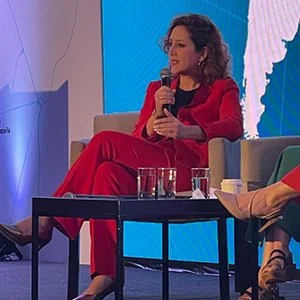
Interview with Alexandra Delgado Jiménez
Today we have the pleasure of introducing Alexandra Delgado Jiménez: PhD in Architecture and Urban Planning, professor of the Advanced Planning Workshop for the Master’s in Architecture at Nebrija University, lead researcher at At-the-oUtset, and founder of AD Arquitectura Urbana.
Through an analysis of the challenges of contemporary urbanism, architect Delgado delves into fundamental questions regarding urban evolution and the impact of sustainable planning on the social fabric. Access the full interview here: VisualUrb Link
What drove you to study architecture?
AD: Well, I actually didn't know what to study because I was interested in everything. It was as a result of the Ruta Quetzal trip when I was 16, when I discovered the cities of Bolivia—with that grid, that order—and I fell in love with urbanism and decided to become an architect; I wanted to design cities. It was an initiatory journey. Miguel de la Quadra always repeated the aphorism "Know thyself," and I truly got to know myself on that trip. I am very glad I chose architecture.
Your doctoral thesis analyzed the evolution and crisis of the Madrid region. If you had to update it today, what would be the new chapter or the main argument you would add?
AD: I think the most important thing I would add is the current role of society—citizen participation. Our organization as a community would allow us to achieve goals of greater social justice.
"Urbanism without people is just design."
The most interesting part is the possibilities of planning at the service of life.
As part of beBartlet’s Knowledge Unit, how can the gap be closed between academic research in urbanism and political decision-making in the day-to-day operations of city councils?
AD: I am part of it along with many colleagues, such as Manuel Franco or Irene Lebrusán, to name a few. I believe the most important thing to bridge the gap is to apply academic research to applied case studies. Whether they are simple or complex, they must be measurable to see the improvement in the quality of life for residents—for all of us. Basic research is key, because we often need to search without knowing where we will apply it. But when it is applied, that is the true satisfaction: the transfer of knowledge to work not "as it has always been done," but as we need it to be done for our common future.
In the context of the climate crisis, what role does the redesign of cities that emerged in the early 2000s during the "real estate boom" play?
AD: In territories like Europe, the keyword is transformation, because it is an almost entirely anthropized territory where humans have changed everything, even what is seemingly natural. During the real estate boom, the quantity and speed of urban development processes often took precedence over environmental quality. The redesign of cities, where population and resource consumption are concentrated, has the great potential to serve our quality of life, closing the cycles of materials, energy, water, and resources, while increasing social justice and territorial rebalancing. But these ideas must materialize into plans, projects, and operations. We must move from the muses to the stage.
You received the METREX Bernd Steinacher International Grant for young urban planners. How has this international perspective influenced your way of understanding and analyzing local urban problems in Spain? Is what is seen outside our borders very different?
AD: Being able to travel, collaborate with other colleagues abroad, and work in other countries has shown me that we all have common problems, though it is the priorities that change.
I have been asked that question many times. I believe all urban realities have much in common—the built environment, natural and artificial flows, and nature—and what differentiates us is the proportion between them and the role of society in the urban narrative.
The central premise of Energy Transition and Social Construction of the Territory, a book you edited alongside Roberto Álvarez and Joaquín Farinós, is that for the energy transition to be fair and effective, it must be a process of social and democratic construction of the territory with active citizen participation. Where should we start for this to become a reality?
AD: We need to make it known that the energy transition toward renewable sources is a revolution, just as the Neolithic or Industrial Revolutions were in the past. But in those instances, there wasn't always a collective awareness that we are actors of change. The current energy transition needs the territory for its deployment, with roofs full of solar panels in our cities or wind farms in our landscape, to name a few examples. We must be aware of the change this entails and that, together with a decrease in consumption, we can reach the energy autonomy of territories. But this involves affecting local communities, our towns, and neighborhoods. How do we do it? Either we are part of the decision-making or others will make the decisions for us. We have to raise awareness, because with strategy and generosity, it is something that can be positive for everyone.
If you had unlimited resources and power to implement a single transformative measure in Madrid’s urbanism, what would it be?
AD: What a difficult and yet easy question. I would reduce spatial poverty, which I define as the lack of access to facilities and services, to nature, and to urban green areas, as well as a lack of diversity in the urban fabric with little mix of uses. It also has a component of energy poverty, with its associated vulnerability. I would start with the most disadvantaged neighborhoods so that everyone would have a better chance of achieving their dreams and living with dignity. Space, the environment, gives us wings or it can imprison us.
What advice would you give to a young urban planner or architect starting their career today? What skills, beyond technical ones, are fundamental to having a real impact?
AD: As one of the most inspiring urbanists for me, Paola Viganò, says: the future is designed. I apply that advice to my daily life. You can make of the future whatever you want. Even if we inherit ideas or realities, everything can be changed. You have to believe in the process and not expect too much too soon. The small makes the great; the little makes the much.
The main skill is maintaining trust in your fellow travelers in the work—which is always collective—and in the process: trust generates trust. And also, to be critical of reality, always thinking about whether what we do or what we see is what is desirable.